

Keyword Research Explained Simply — With Real-Life Examples
Think of keyword research like setting up a lemonade stand. Before you decide what flavour to sell or where to put your table, you’d want to know what people nearby are actually thirsty for. That’s what keyword research does for websites. It helps you find out what people are typing into Google so you can create content or pages that show up right when they need it. Let’s break this into four key areas: search intent, search volume, keyword difficulty, and traffic potential — all explained in simple terms, but with clarity a business owner can respect.
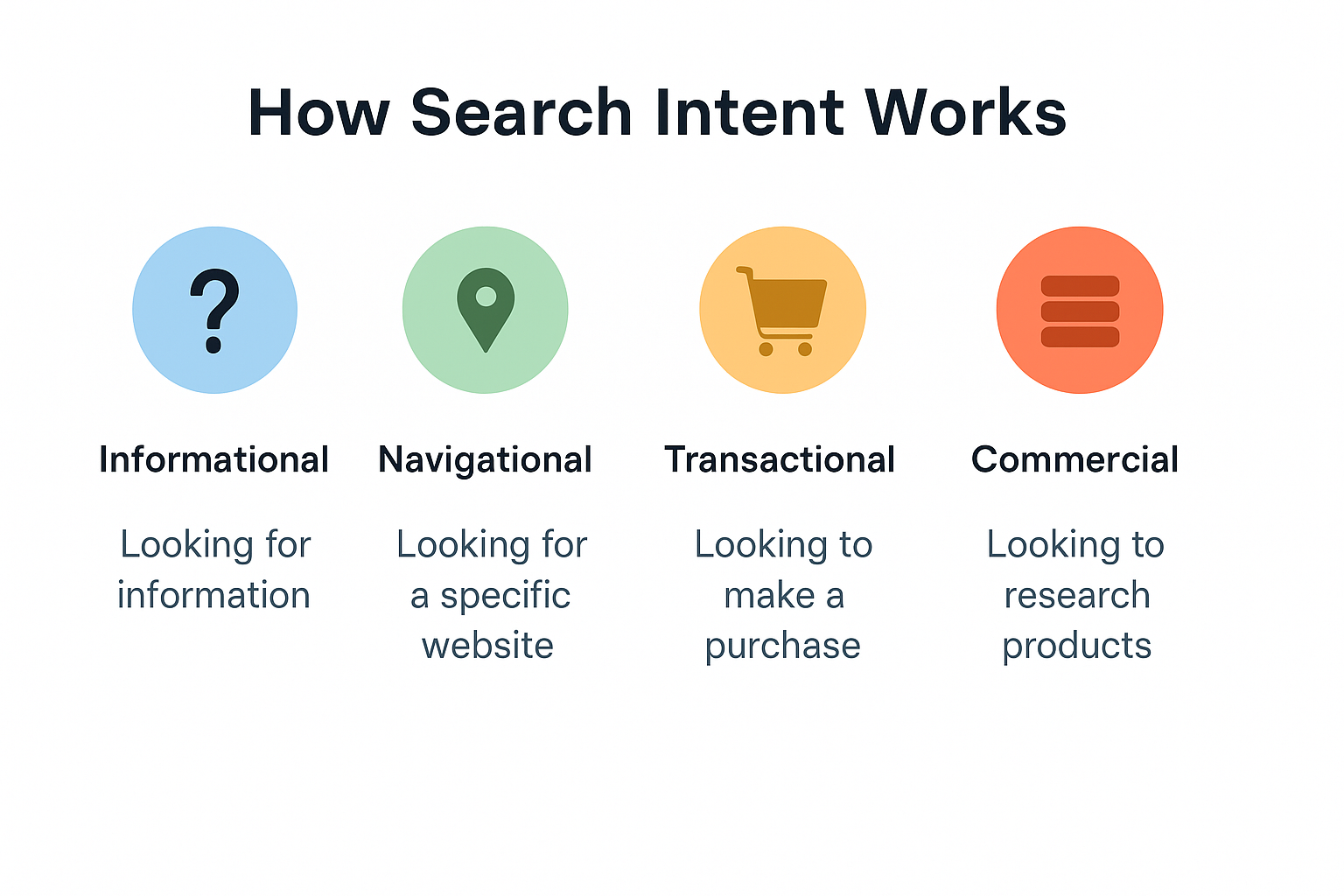
Search Intent: What Is the Searcher Actually Trying to Do?
Imagine someone types “how to make lemonade” into Google. They probably want a recipe, not to buy lemonade. But if they type “lemonade stand near me,” they’re ready to buy. That’s the difference in search intent — understanding what the person behind the search actually wants.
In keyword research, this matters because matching your content to the right intent is what makes it valuable. If you’re a business owner, and your page offers products, you want to target terms like “buy,” “best,” or “near me.” If someone’s just researching, they’ll be using words like “how,” “what is,” or “guide.”
For example, if you run a local sneaker store, the search “comfortable sneakers for nurses” shows someone’s ready to shop with a specific need. But “history of sneakers” is likely a student doing research. Understanding this difference means you’re not wasting time creating the wrong kind of content for your audience.
Search Volume: How Many People Are Asking the Same Thing?
Search volume tells you how many people type a certain keyword into Google each month. It’s a way to measure demand. For instance, if 10,000 people a month search for “best walking shoes,” that’s a big audience. But if only 30 people a month search for “leather walking shoes for tall teenagers,” it’s a much smaller group.
That doesn’t mean low-volume keywords are useless — sometimes they’re very specific and lead to better sales. But as a general rule, the higher the volume, the more opportunity to attract visitors.
Think of it this way: setting up a lemonade stand where 1,000 people pass by is better than placing it on a quiet street with just 10 people. Unless those 10 people are guaranteed buyers, the higher foot traffic gives you more chances to make a sale.
When doing keyword research, balancing high-volume keywords with those that are specific and relevant to your business is what helps you capture both visibility and intent.
Keyword Difficulty: How Competitive Is the Keyword?
Not all keywords are easy to rank for. Keyword difficulty shows how hard it would be to appear on the first page of search results for a given term. If big sites like Amazon or Nike already rank for “running shoes,” it’s going to be hard to beat them — especially if your website is smaller or newer.
Instead of going after broad, competitive terms, you can target more specific ones. These are sometimes called “long-tail keywords.” They have less competition and are more focused, like “breathable running shoes for summer.”
It’s like trying to become school president versus signing up to run a small event committee — fewer people competing means you have a better chance of standing out. In SEO, especially for small businesses or newer sites, picking keywords with lower difficulty gives you more room to grow steadily.
That doesn’t mean low-volume keywords are useless — sometimes they’re very specific and lead to better sales. But as a general rule, the higher the volume, the more opportunity to attract visitors.
Think of it this way: setting up a lemonade stand where 1,000 people pass by is better than placing it on a quiet street with just 10 people. Unless those 10 people are guaranteed buyers, the higher foot traffic gives you more chances to make a sale.
When doing keyword research, balancing high-volume keywords with those that are specific and relevant to your business is what helps you capture both visibility and intent.
Traffic Potential: What Could This Keyword Really Deliver?
Search volume shows how many people are searching — but traffic potential looks at what kind of results you could get if you rank well. Some keywords bring in way more traffic than the volume suggests because they connect to lots of related searches.
For example, if you rank for “how to clean white sneakers,” you might also show up for related terms like “remove stains from sneakers” or “best cleaner for shoes.” That one keyword opens the door to many clicks.
It’s like setting up your lemonade stand at a soccer tournament — people come for one thing but may also grab snacks, ask for cold water, or tell others to stop by. One spot, many outcomes.
So instead of only chasing keywords with big numbers, look for the ones that open doors. A keyword with decent volume but high traffic potential can outperform one that looks bigger on the surface.
Instead of going after broad, competitive terms, you can target more specific ones. These are sometimes called “long-tail keywords.” They have less competition and are more focused, like “breathable running shoes for summer.”
It’s like trying to become school president versus signing up to run a small event committee — fewer people competing means you have a better chance of standing out. In SEO, especially for small businesses or newer sites, picking keywords with lower difficulty gives you more room to grow steadily.
That doesn’t mean low-volume keywords are useless — sometimes they’re very specific and lead to better sales. But as a general rule, the higher the volume, the more opportunity to attract visitors.
Think of it this way: setting up a lemonade stand where 1,000 people pass by is better than placing it on a quiet street with just 10 people. Unless those 10 people are guaranteed buyers, the higher foot traffic gives you more chances to make a sale.
When doing keyword research, balancing high-volume keywords with those that are specific and relevant to your business is what helps you capture both visibility and intent.